
Zitroen IoT Private Limited is an India-based technology company specializing in solar lighting, LED lighting, and smart IoT-enabled solutions.
Office No- 04, Sr.No - 27/1, Mamta complex, Bhosale Industrial Estate, Zeel College Road, Narhe, Pune - 411041.

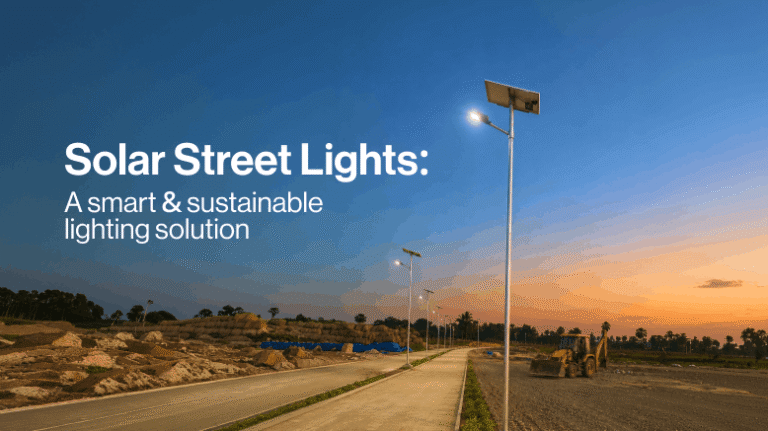
Outdoor lighting infrastructure is undergoing a quiet revolution. As cities, industrial parks, and rural panchayats look for ways to cut electricity costs and reduce their carbon footprint, solar street lights have emerged as one of the most practical answers available today. Unlike conventional grid-powered fixtures that depend on underground cabling and a continuous electricity supply, solar street lights generate, store, and use their own power, making them an ideal fit for both well-developed cities and remote, off-grid locations.
This guide breaks down how solar street lights function, the real advantages they offer over traditional lighting, and what to look for before choosing a system for your project.
A solar street light is a self-contained lighting unit built around four core components: a solar photovoltaic (PV) panel, an LED light fixture, a rechargeable battery, and a smart charge controller.
During daylight hours, the solar panel absorbs sunlight and converts it into direct current (DC) electricity through the photovoltaic effect. This energy is routed through the charge controller into a rechargeable battery typically lithium-ion or LiFePO4 in modern systems where it is stored for later use. As dusk falls, a built-in light sensor or timer automatically triggers the LED luminaire, drawing power from the battery to illuminate the area through the night. By sunrise, the cycle resets and the panel begins recharging again.
Because the entire system runs independently of the public electricity grid, solar street lights continue operating reliably even during power outages, in areas where grid connections are unavailable, or in newly developed zones where laying cables would be expensive and time-consuming.
Solar lighting systems are now a standard feature in several types of projects, including highways and arterial roads, industrial estates and warehouses, public parks and walking paths, residential townships and gated communities, construction and infrastructure sites, and rural or off-grid electrification programs under government schemes.
Not every solar street light is built to the same standard, and choosing the wrong specification can mean dim lighting or a shorter lifespan. Before purchasing, it’s worth evaluating the wattage and lumen output against the area to be lit, the battery type and its expected charge cycles, the IP rating for weather and dust resistance, the autonomy days (how many cloudy days the battery can sustain lighting without sun), and whether the manufacturer offers a warranty and after-sales service. Working with an experienced solar lighting manufacturer that tests its products for Indian weather conditions, heavy monsoons, high humidity, and dust generally results in better long-term performance than opting for the lowest-priced option available.
Do solar street lights work during monsoon or cloudy weather? Yes. Quality systems are designed with battery backup for two to three cloudy days, and lithium-based batteries continue charging even under diffused sunlight, though charging speed is reduced.
How long do solar street lights last? With proper installation, LED fixtures typically last 50,000+ operating hours, while lithium batteries are rated for 2,000+ charge cycles, translating to roughly 8 to 10 years of usable life with minimal maintenance.
Are solar street lights more expensive than electric ones? The initial cost is higher, but there is no recurring electricity bill, and savings on energy and maintenance usually recover the extra upfront cost within three to five years, depending on usage hours and local tariff rates.
As power costs rise and sustainability becomes a non-negotiable part of infrastructure planning, solar street lights offer a practical way to light up roads, campuses, and rural communities without adding pressure to the electricity grid. For project planners, municipal bodies, and private developers alike, switching to solar lighting is no longer just an environmental choice it’s a financially sound one too.